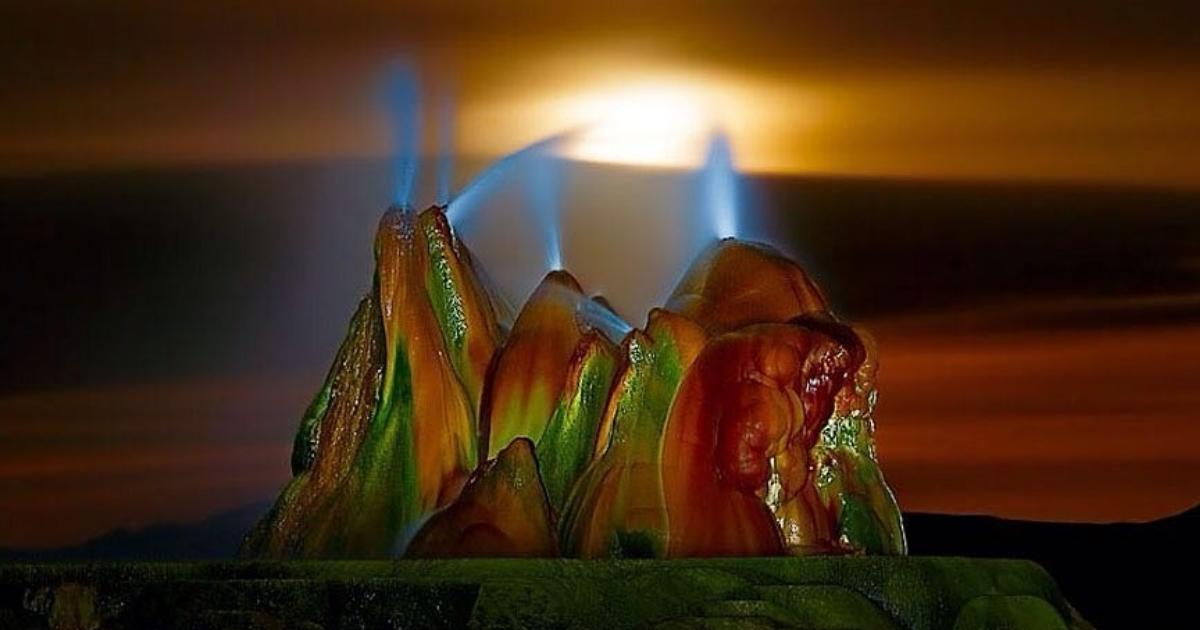
Lugares Increíbles que Realmente Existen: Géiser Mosca!
Una combinación de error humano y presión geotérmica natural creó esta maravilla geológica de colores del arcoíris.
Este géiser de aspecto extraterrestre, situado al borde del Desierto de Black Rock, es en realidad artificial. O, mejor dicho, accidental.
En realidad, hay dos géiseres en la propiedad. El primero se creó hace casi 100 años como parte de un proyecto para hacer cultivable una zona del desierto. Se perforó un pozo y se encontró agua geotérmica hirviendo (a 200 grados). Obviamente, no era apta para el riego, así que se dejó el géiser sin intervenir y se formó un cono de carbonato de calcio de entre 3 y 4 metros de altura.
En 1964, una empresa de energía geotérmica perforó un pozo de prueba en el mismo lugar. El agua que encontraron también estaba a 200 grados. Caliente, sí, pero no lo suficiente para sus propósitos. Supuestamente, el pozo se volvió a sellar, pero al parecer no resistió. El nuevo géiser, situado a unos cientos de metros al norte del original, le arrebató la presión del agua, y ahora su cono está seco.
Este segundo géiser, conocido como Géiser Mosca, ha crecido considerablemente en los últimos 40 años a medida que los minerales de la bolsa de agua geotérmica se depositan en la superficie del desierto. Debido a la presencia de múltiples chorros, este géiser no ha creado un cono tan grande como el primero, sino un montículo de aspecto extraterrestre en constante crecimiento.
El géiser está cubierto de algas termófilas, que proliferan en ambientes húmedos y cálidos, lo que da como resultado las múltiples tonalidades de verde y rojo que contribuyen a su apariencia de otro mundo.
Unbelievable Places That Really Exist: Fly Geyser!
A collision of human error and natural geothermal pressure created this rainbow-colored geologic wonder.
This alien looking geyser on the edge of Black Rock Desert is actually man made. Man made by accident, that is.
There are actually two geysers on the property. The first was created nearly 100 years ago as part of an effort to make a part of the desert usable for farming. A well was drilled and geothermal boiling water (200 degrees) was hit. Obviously not suitable for irrigation water, this geyser was left alone and a 10 to 12 foot calcium carbonate cone formed.
In 1964 a geothermic energy company drilled a test well at the same site. The water they struck was that same 200 degrees. Hot, but not hot enough for their purposes. The well was supposedly re-sealed, but apparently it did not hold. The new geyser, a few hundred feet north of the original, robbed the first of its water pressure and the cone now lays dry.
This second geyser, known as Fly Geyser, has grown substantially in the last 40 years as minerals from the geothermal water pocket deposit on the desert surface. Because there are multiple geyser spouts, this geyser has not created a cone as large as the first, but an ever growing alien looking mound.
The geyser is covered with thermophilic algae, which flourishes in moist, hot environments, resulting in the multiple hues of green and red that add to its out-of-this-world appearance.